Blood Quantum Q and A
Tuesday, April 12, 2022

Blood Quantum Q & A

In the past year, Sealaska has hosted a variety of conversations on Native identity and conducted extensive outreach to shareholders and descendants about the issue. The purpose of these efforts was to better understand how blood quantum impacts our community, and to provide background and context to shareholders. 

Topics included how blood quantum was incorporated into the Alaska Native Claims Settlement Act, its history related to enrollment requirements at Sealaska, what tribes and other Alaska Native Corporations require, cultural values related to the issue, a glimpse into what the population of Sealaska shareholders and descendants looks like in the future, and answers to questions from participants. Included below are responses to some of the questions we received.
Q: What is blood quantum?
The term “blood quantum” is used to refer to the amount of Alaska Native or American Indian blood a person has. Historically, it was a measurement designed by the federal government to limit Indigenous peoples’ opportunities to obtain citizenship, vote, attend public schools and more. Over time, the government’s version of how to define whether or not someone is Alaska Native or American Indian was adopted by tribes and other entities to determine eligibility for enrollment and other services.

Q: Where did the concept of blood quantum originate?  
Quantifying blood quantum first began in the United States in the early 1700s in the Colony of Virginia, where it was used to limit the rights of anyone who was more than half Native. It was carried forward into the 19th and 20th centuries to limit the federal government’s treaty obligations to Natives—no more Natives, no more obligations. Eventually, tribes started relying on blood quantum in their enrollment requirements with the passage of the Indian Reorganization Act of 1934.  

Q: How is blood quantum used today? 
Today, tribes and Alaska Native corporations can define eligibility requirements for themselves.  When the Alaska Native Claims Settlement Act was passed into law in 1971, it contained an eligibility standard of one-quarter Alaska Native blood quantum. Today, 10 of the 12 Alaska Native regional corporations maintain the requirement of one-quarter or more Native blood quantum for enrollment, including Sealaska.

Q: Which tribes or Native corporations have eliminated the blood quantum requirement?

Many tribes, like Central Council of the Tlingit and Haida Indian Tribes of Alaska, rely on documented lineal / biological relationships (“lineal descent”) to an established tribal member rather than blood quantum.  According to a 2016 study, approximately one-third of Lower 48 tribes do not use blood quantum to determine eligibility.

ANCSA was amended in 1991 to allow shareholders of Alaska Native corporations to determine for themselves what standards should be used to determine eligibility.   Shareholders of Arctic Slope Regional Corporation and Calista voted to remove the blood-quantum requirement for their companies. 

Q: What does Sealaska require to enroll? 
To enroll with Sealaska, lineal descendants must be one-quarter Alaska Native blood quantum (including Tsimshian people who are not enrolled in the Metlakatla Indian Community, Eskimo or Aleut blood, or combination thereof).

Q: What is a direct lineal descendant?
A person who is the child, grandchild, great grandchild, etc. of an original Sealaska shareholder. Descendants must be able to document a direct ancestor as an original Sealaska shareholder.

Q: Why does Sealaska want to expand eligibility by removing blood quantum requirements? 

In 2007, Sealaska shareholders passed a resolution to create Descendant (Class D) stock to address the arbitrary nature of ANCSA’s original eligibility requirements, which stipulated that enrollees had to have been born by December 18, 1971. Extensive demographic surveys conducted ahead of that vote clearly illustrated that Native blood quantum in the population would continue to decline. The 2022 resolution is an extension of the principle behind the 2007 campaign — we live in a global and rapidly changing society and must adapt our qualifications to ensure our young people remain connected to Sealaska and their culture.   

Q: What is the potential financial impact to Sealaska shareholders if blood quantum requirements are removed?
Our current estimate for the number of eligible descendants if the one-quarter blood quantum requirement is eliminated is 17,000. Based on historical data, we expect about 8,500 of those eligible would enroll within the first six years. If that estimate is correct, dividends could be reduced by as much as 40%. However, that estimate does not account for growth in operational income, which has been a consistent trend over the past several years and could offset any reduction.

Q: What is the potential financial impact to Sealaska if blood quantum requirements are removed?
Sealaska has been investing greater and greater amounts of money into shareholder benefits since 2015, many of which are already available to descendants, such as the scholarship program. We plan to continue this trend. The success of our operating businesses and investments has allowed us to increase our support for shareholders and descendants while continuing to grow our business.

Q: If blood quantum requirements are removed, is there a certain age lineal descendant must be?
To enroll in Sealaska, descendants must be 18 years of age.

Q: What are the alternatives to blood quantum requirements? 
There are a wide range of eligibility requirements throughout Indian Country. Some tribes in the Lower 48 require up to 50% Native blood quantum, while others set the standard at one quarter, one eighth, 1/64th and zero. For those without blood quantum requirements, lineal descent is usually the standard.  

For tribes like Tlingit & Haida, determining whether someone is a lineal descendant involves providing an original birth certificate listing both parents. For people who were adopted, or for those whose paternity is unknown, an affidavit may be provided to confirm identity.

Q: I thought shareholders approved removing blood quantum in 2007?
In 2007, Sealaska shareholders voted to open enrollment to descendants of original shareholders (those born after 1971) and people who were eligible but for a variety of reasons “left out” of the original enrollment process in 1971. However, the one-quarter Native blood quantum requirement remained, and is still the requirement today.  

In 2007, Sealaska shareholders also approved the creation of Class E (Elders) stock to help ensure the value of original shares was not diminished by adding new shareholders. 

Sealaska estimates that there are approximately 15,000 lineal descendants of original shareholders that are currently not qualified to enroll as descendants. 

Q: There’s already a way for lineal descendants to become shareholders, through gifting and inheritance. Why do we need to do this?
Right now, the only way for someone with less than one-quarter blood quantum to become a shareholder is via a gift or inheritance from a friend or relative. Sealaska data show that of the original shares that have been passed to others through gifting and inheritance, only 7% are owned by descendants with blood quantum lower than one-quarter. In short, we do not believe gifting and inheritance are working to include future generations. 

Q: What are gifted shares?
Shares that a shareholder has given to a child, grandchild, great grandchild, brother, sister, niece or nephew. 

Q: What are inherited shares?
Original shares that have passed, either by will or by law, upon the death of the original shareholder. 

Q: Why now? 
The 50th anniversaries of the Alaska Native Claims Settlement Act (in 2021) and Sealaska (in 2022) have led us to consider both the intent of the original legislation and to look ahead to how our company will be governed and remain strong over the next 50 to 100 years. Readily available demographic data tells us this issue will be of increasing importance in the coming decades.


News Search

Reset Search

27 results found
Posted 8/15/2025
Posted 8/15/2025
August 15, 2025 — Sealaska and Sitka Tribe of Alaska (Sitka Tribe) have signed the Interim Ḵunáa Historic Site Management Agreement. This agreement empowers Sitka Tribe to manage the 10.54 acres above mean high tide at Redoubt Falls (Ḵunáa). Ḵunáa, also known as Redoubt Bay Village, historically belonged to the Kiks.ádi and affiliated clans, with substantive historical importance as a…

Posted 12/13/2024
Posted 12/13/2024
We are pleased to announce that Tlingit & Haida Executive Council and Sealaska board of directors met to engage in meaningful discussions on issues that matter most to tribal citizens and shareholders. This collaborative meeting was an important step toward finding pathways to create mutually beneficial outcomes while strengthening entities to better serve people and communities.

Posted 9/30/2024
Posted 9/30/2024
This year’s elections hold significant importance for us all, which is why we are encouraging all shareholders and tribal citizens to get out and vote – and bring a loved one, too! Voting is one of the most powerful ways to make your voice heard. Every vote counts, and your participation can help shape the future of our communities. Make sure you’re prepared for election day by having a…

Posted 12/9/2023
Posted 12/9/2023
In a year marked by significant growth, Sealaska’s Board of Directors announced that it remains excited about 2023’s financial performance and looks forward to significant growth planned for 2024. The company’s ocean health business platform, Woocheen, LLC, continues to expand its scope of work around the planet, most recently through Seas Geosciences, LLC’s work on the first floating offshore…

Posted 11/7/2022
Posted 11/7/2022
Sealaska published a special edition Shareholder Newsletter. The following was included. Following the June 25 approval of a shareholder resolution to eliminate the one-quarter blood quantum requirement from the eligibility criteria for Sealaska’s Class D (Descendant) shares, Sealaska is now pursuing justice on behalf of another group of disenfranchised descendants — those who were born…

Posted 7/28/2022
Posted 7/28/2022
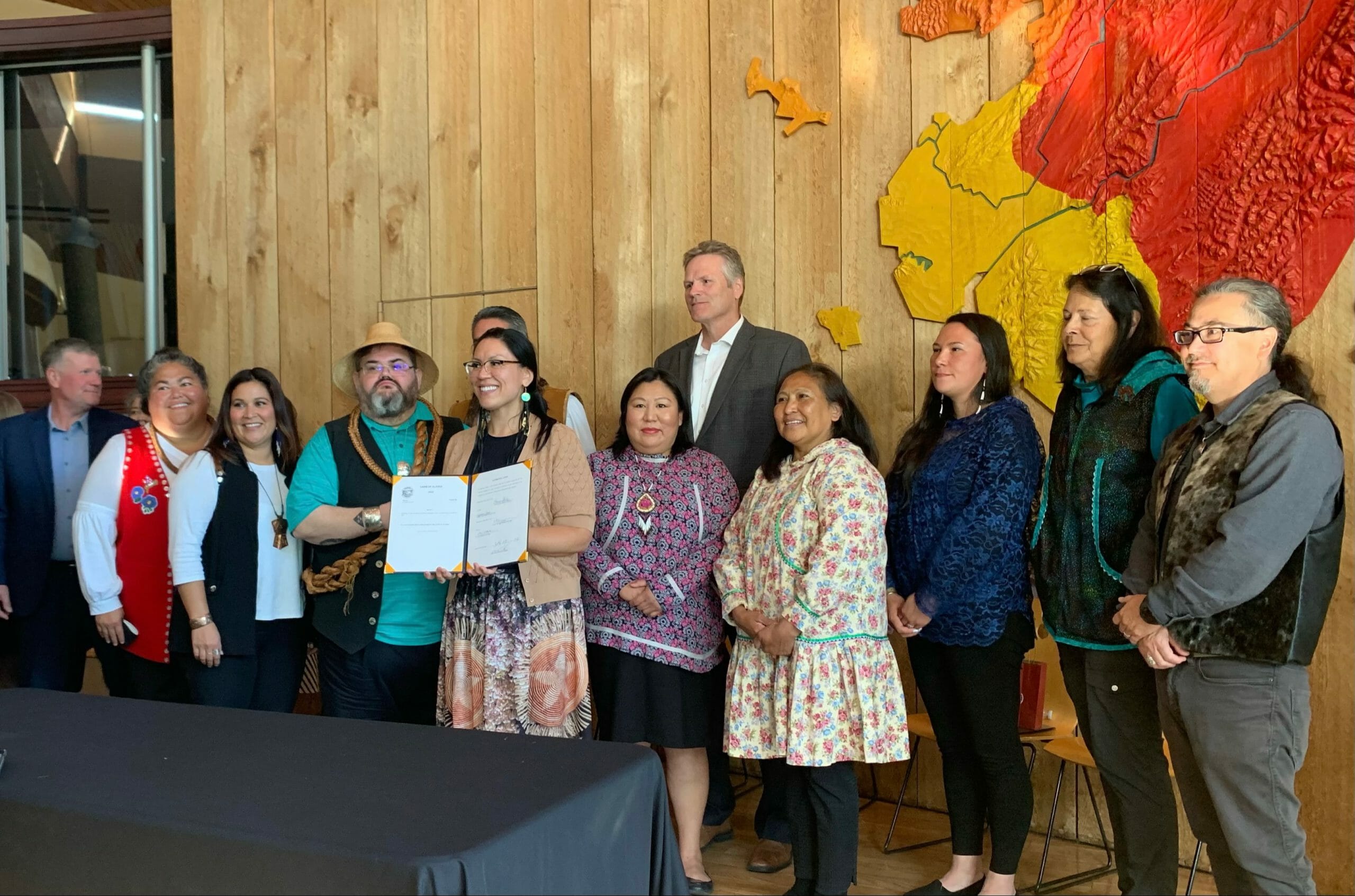
Today, Alaska Governor Mike Dunleavy signed House Bill 123, the Alaska Tribal Recognition Act – legislation that generations of Alaska Native advocates have worked tirelessly to bring about. This specific piece of legislation was sponsored by Representative Tiffany Zulkosky of Bethel and championed by Alaska Native leaders from around the state, including Sealaska’s board of directors.

Posted 6/23/2022
Posted 6/23/2022
The Alaska Native Brotherhood and Alaska Native Sisterhood Grand Camp approved a resolution on Thursday, June 16 to support Sealaska’s proposal to remove as a criteria for eligibility for Class D stock the requirement that applicants have at least one-quarter Alaska Native blood quantum. The issue is currently in front of Sealaska shareholders, who have until this Friday, June 24 at 5 p.m.

Posted 5/2/2022
Posted 5/2/2022
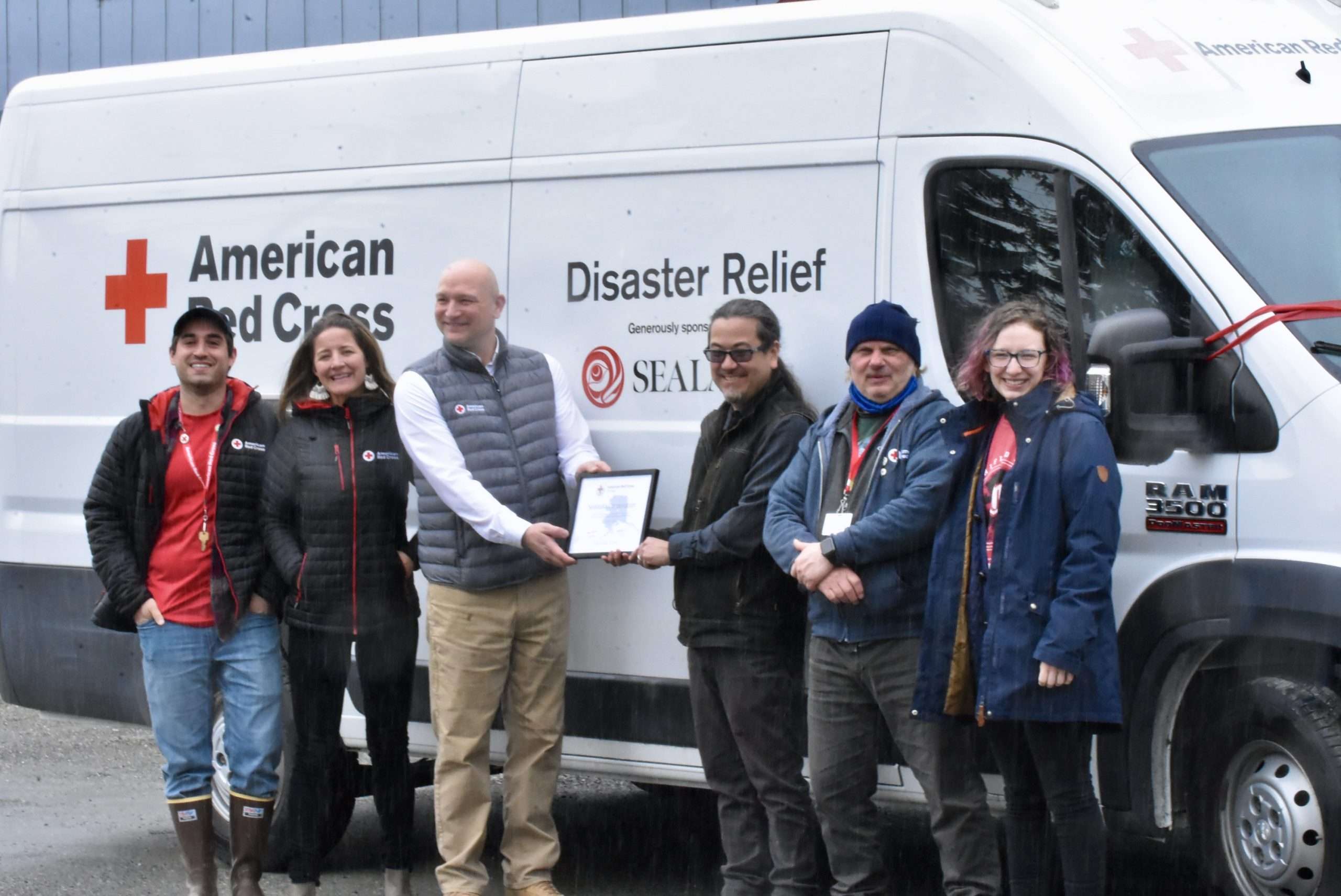
Sealaska has sponsored a Community Emergency Vehicle (CEV) to be based in Juneau. This vehicle will enable Red Cross staff and volunteers to provide support and relief to southeast Alaska communities. “The Dodge Promaster van will be used to serve communities efficiently and effectively. Having this additional resource in our southeast towns means the Red Cross can be there when we are needed…

Posted 4/21/2022
Posted 4/21/2022
Resources This page hosts a collection of published articles by Sealaska, news organizations, academics, researchers, podcasters and others on the issue of blood quantum.  Sealaska Blood Quantum Information 1. Academic Research Original Shareholders of Sealaska and their Descendants, Estimates and Projections, by Barry Edmonston, 2005 (PDF) ...

Posted 4/12/2022
Posted 4/12/2022
How Many Shareholders? Based on estimates produced by Sealaska, there are approximately 15,000 descendants of original shareholders who have less than one-quarter Alaska Native blood quantum. This estimate is based on comparing the number of shareholders currently in Sealaska with the number of enrolled tribal citizens of Central Council of the Tlingit and Haida Indian Tribes of Alaska, along...

Posted 3/18/2022
Posted 3/18/2022
Sealaska was saddened to learn of the passing of Alaska U.S. Representative Don Young, and would like to extend our deepest and most heartfelt condolences to his family, friends and colleagues. Congressman Young served our state since 1973 and has been a staunch and loyal supporter of Sealaska and our Alaska Native community over the years. Congressman Young was a tireless advocate on behalf…

Posted 1/21/2022
Posted 1/21/2022
Every two years, Sealaska conducts a shareholder survey to identify your priorities. Those priorities are the road map to our public policy work and help guide the shareholder benefits we are grateful to be able to provide through the success of our businesses. In 2021, Sealaska’s board and executive leadership launched what will be a multiyear effort to hold leadership meetings in…

Posted 11/22/2021
Posted 11/22/2021
Sealaska recently joined Alaskans for Better Government in support of a proposed ballot measure to institute formal legal recognition of all 229 Alaska Native Tribes by the State of Alaska. This ballot initiative would provide Alaskans – rather than the Legislature – a chance to vote on the matter directly and finally ensure an equal, government-to-government relationship between Tribes and the…

Posted 11/4/2021
Posted 11/4/2021
ANCSA Corporations and Tribes ANCSA Corporations and tribes serve many of the same constituents – both have a mission to improve the lives of our shareholders and tribal citizens.Relationship can be collaborativeSupporting traditional ways of life (subsistence)Sustainable rural communities; employmentEducationCultural and language preservationLand into trustCelebration 1998There can be disagr...

Posted 10/5/2021
Posted 10/5/2021
Sealaska will begin accepting applications for its CARES Act distribution in partnership with the Central Council of the Tlingit and Haida Tribes of Alaska on Monday, Oct. 4. We have compiled the following answers to questions we’ve received so far. Do you have a question that isn’t addressed here? Email us at sealaskacares@ccthita-nsn.gov. We’ll update this Q&A throughout the application period.

Posted 9/1/2021
Posted 9/1/2021
After 23 years of law enforcement service, Alaska State Trooper Mark Granda retired on Aug. 31, 2021. Like his family, Sealaska is proud of Trooper Granda and his honorable service to the people of Alaska. Granda’s career in law enforcement began in 1997 with the Sitka Police Department, where he served for nearly four years. In 2001, Granda began his career with the Alaska State Troopers…

Posted 8/31/2021
Posted 8/31/2021
Many shareholders are asking about Sealaska’s CARES Act funding, and how the $4.2 million amount of its allocation was determined. The U.S. Department of the Treasury created the formula for how CARES Act money was allocated to tribes and Alaska Native corporations (ANCs). The most important thing is that Alaska Natives in Southeast Alaska are receiving additional support at a crucial time.

Posted 6/25/2021
Posted 6/25/2021
Sealaska issued a statement expressing its position on the U.S. Supreme Court’s ruling on Friday, June 25 that settled litigation over whether Alaska Native Corporations qualify for federal CARES Act funding. Click here to read Sealaska’s statement. Answers to additional questions shareholders and tribal citizens may have on the decision and Sealaska’s role are below.

Posted 6/25/2021
Posted 6/25/2021
The U.S. Supreme Court’s decision today affirms the critical importance of our nation’s support for Alaska Natives, many of whom live in remote, rugged environments with limited infrastructure and services, including healthcare. Alaska Native communities face longstanding vulnerabilities that worsen their coronavirus risk, and Alaska Native Corporations are uniquely positioned to assist them.

Posted 8/5/2020
Posted 8/5/2020
Each year, Sealaska directors select a shareholder descendant to participate as a board youth advisor to the board for a one-year term. Michaela Demmert from Juneau was selected for the board youth advisor position for the coming year. In her role as board youth advisor (BYA), Michaela serves as a non-voting member on the board and will be asked to provide input, while learning about the company’s…

Posted 7/23/2020
Posted 7/23/2020
Sealaska’s emergency allocation of $1.28 million to assist tribes and other organizations serving shareholders and descendants in Southeast Alaska and beyond is at work in communities, providing groceries and assistance with utilities and other expenses for Elders, feeding schoolchildren and vulnerable families, providing jobs and much more. The Sealaska board of directors approved the COVID…

Posted 7/22/2020
Posted 7/22/2020
The coronavirus is exposing longstanding vulnerabilities that our Alaska Native communities have faced for years. Many of our people are more at risk because of factors related to high rates of diabetes and heart disease. These conditions faced by Alaska Natives — many living in remote, rugged environments with limited infrastructure and services, including healthcare — further exacerbate the risk…

Posted 4/18/2020
Posted 4/18/2020
The coronavirus is exposing longstanding vulnerabilities that our Alaska Native communities have faced for years. Many of our people are more at risk because of factors related to high rates of diabetes and heart disease. These conditions faced by Alaska Natives — many living in remote, rugged environments with limited infrastructure and services, including healthcare — further exacerbate the risk…

Posted 4/9/2020
Posted 4/9/2020
Applications for Sealaska’s scholarships close on April 15th! A scholarship can be a tremendous source of support. Over the course of the next week, we’ll bring you stories of former scholarship recipients who are pursuing great careers and making a difference in our communities. For more information on scholarships and how to apply, go to the shareholder portal MySealaska.

Posted 12/20/2019
Posted 12/20/2019
Sealaska is partnering with Central Council of the Tlingit and Haida Indian Tribes of Alaska (Tlingit & Haida) and Sealaska Heritage Institute (SHI) to host a community gathering in Roseville, CA on Saturday, Jan. 11. The event is an opportunity for shareholders and tribal citizens that live away from their traditional homelands to connect with their culture and learn more about the three…

Posted 3/19/2019
Posted 3/19/2019
Sealaska is growing, and that growth is rooted in core businesses that are working to manage healthy lands, create exponential value and demonstrate sustainable stewardship. Our recent financial stability has enabled us to increase investments in what we care most about: our people and communities. This October, Sealaska invested in a local community program that directly betters elders in rural…